
English| EUR
Suggested for you
More currencies
Choose a language
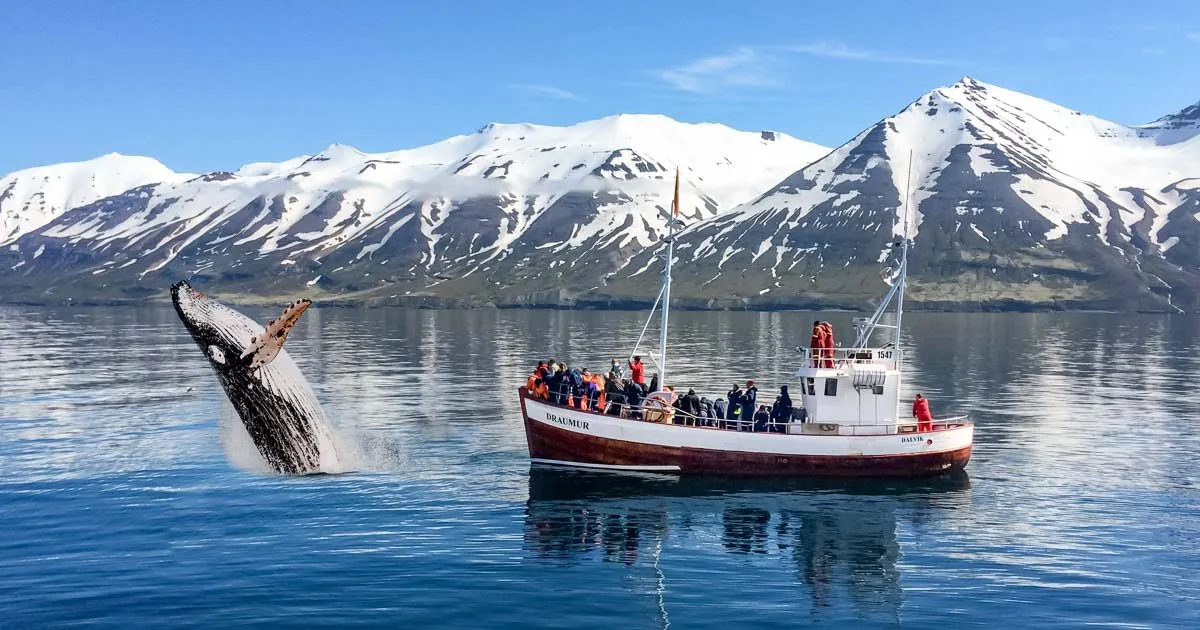
Both Dalvik and Husavik offer humpback whale encounters from April through October, but they differ in departure frequency, tour style, and transit time from Akureyri. This guide compares the two ports across logistics, wildlife sightings, and onboard experience so you can match your schedule and expectations to the right departure point.
Quick answer
Dalvik operates fewer daily departures with intimate group sizes and a 25-minute drive from Akureyri, while Husavik schedules more frequent tours with larger vessel options and sits 90 minutes northeast of the regional hub. Humpback whales appear in both feeding grounds with comparable frequency during peak summer months, though Husavik's position near Skjálfandi Bay historically records higher minke whale sightings and Dalvik's Eyjafjörður offers sheltered conditions when coastal wind picks up. Your choice hinges on transit tolerance, preferred group size, and daily itinerary rather than species variety.
Eyjafjörður and Skjálfandi Bay share the same North Atlantic feeding corridor, drawing humpback whales to krill-rich upwellings between late April and mid-October. The ecological overlap means neither port holds a wildlife monopoly, yet the two harbors diverge sharply in operational rhythm and visitor flow. Dalvik remains a working fishing village with a single dedicated whale-watching operator running two to three departures per day from a compact harbor at Hafnarbraut 22. Tours launch from traditional oak boats limited to smaller passenger counts, and the 25-kilometer route from Akureyri via Route 82 takes under half an hour in clear conditions. The fjord's steep walls funnel wind, creating natural shelter that keeps sea state calmer when exposed coastlines turn choppy. Operators here emphasize longer time on the water rather than rapid turnarounds, and the village itself offers minimal tourist infrastructure beyond a small maritime museum and a handful of cafés. The office operates weekdays from 09:00 to 16:00, closing early on Fridays at 14:00, with no weekend staffing for walk-in inquiries. Husavik anchors its identity to whale watching, branding itself the whale capital of Iceland and accommodating a dozen operators with staggered schedules from early morning through evening. The larger vessel fleet includes converted fishing trawlers and rigid inflatables, giving travelers a choice between enclosed cabin comfort and open-deck proximity. Skjálfandi Bay's exposure to the Greenland Sea delivers stronger currents and rougher conditions in unsettled weather, though the same dynamics concentrate baitfish that attract minke whales alongside humpbacks. The town supports a dedicated whale museum, multiple tour kiosks, and a broader lodging network, making it a self-contained base for multi-day North Iceland itineraries. Drive time from Akureyri stretches to 90 minutes via Route 1 and Route 85, requiring more buffer in tight schedules. When comparing dalvik vs husavik whale watching, the decision distills to proximity versus frequency. Dalvik suits travelers staying near Akureyri who prefer intimate group dynamics and shorter overland transfers, while Husavik accommodates those willing to drive farther for departure flexibility and a wider choice of vessel types. Both ports report humpback sighting rates above 95 percent during June, July, and August, with occasional white-beaked dolphins and harbor porpoises supplementing encounters. Sea conditions rather than species density become the variable that most affects experience quality, and Eyjafjörður's sheltered topography gives Dalvik an edge when North Atlantic storms track across the region. Booking windows tighten in July regardless of port, so advance reservation through the official operator site remains essential for securing morning departures during peak travel weeks.
“Eyjafjörður and Skjálfandi Bay share the same North Atlantic feeding corridor, drawing humpback whales to krill-rich upwellings between late April and mid-October.”
Visitors choosing between whale watching locations often weigh the quiet, community-focused environment of Dalvík against the high-volume, established infrastructure found in Húsavík. This comparison outlines the practical differences to assist in your travel planning.
| Dalvík Húsavík Recommended | Intimate atmosphere Commercial hub | |
|---|---|---|
| Experience style | Community-focused and quiet | High-volume and tourist-centric |
| Crowd levels | Low density | High density |
| Primary vessel type | Traditional oak boat | Varied (RIBs and traditional boats) |
| Landscape character | Dramatic mountain fjords | Expansive bay vistas |
| Accessibility | Direct harbor access | Centralized port facilities |
Verdict: Choose Dalvík for a more personal, quiet maritime experience or Húsavík if you prefer a location with extensive tourism-oriented amenities.
The best arrival window for whale watching in Dalvík is 09:00–13:00, as morning and midday departures offer the most consistent wildlife sighting opportunities. June through August represent the peak season for marine mammal activity in North Iceland.
Mild, 10°C to 15°C
Peak season with long daylight hours and frequent whale sightings.
Variable, 5°C to 12°C
Shoulder months offer fewer visitors and a high probability of spotting humpback whales.
—
Morning departures provide calmer sea conditions and prioritize consistent wildlife viewing.
Verdict: For the highest probability of sightings and calmer conditions, aim for weekday mornings between June and August.
The Dalvík office maintains regular weekday operations to assist with whale watching inquiries and bookings. The office remains closed during the weekend.
Dalvík is located in Northern Iceland along the Tröllaskagi Peninsula, approximately 45 kilometers north of Akureyri. Access is primarily achieved via Route 82, which provides a direct coastal road connecting the town to the regional hub.
Route 1 to Akureyri, then Route 82 north
Strætó bus line 78 from Akureyri to Dalvík
Walk from local bus stop to harbor at Hafnarbraut 22
Visitors should arrive between 09:00–13:00 to align with scheduled departures. Parking is available near the harbor at Hafnarbraut 22, 620 Dalvík, Iceland.
Preparation and responsible behavior improve your wildlife encounter regardless of whether you choose the calm waters of Dalvík or the traditional bay of Húsavík.
Wear waterproof outer shells, as sea spray and sudden weather shifts are common even on calm days. Cotton retains moisture, so prioritize wool or synthetic base layers for warmth.
Take preventative medication at least one hour before departure if you are prone to seasickness. Focusing on the horizon rather than your camera viewfinder helps maintain equilibrium while the boat is in motion.
Keep voices low and avoid sudden movements when whales surface near the vessel. Noise pollution disrupts the acoustic environment these animals rely on for communication.
Use binoculars with a wide field of view to scan the water surface ahead of the boat. Look for blows or disturbed water rather than focusing solely on the whale body, which allows for earlier sighting and identification.
Follow instructions from your guide regarding boat positioning to minimize impact on whale behavior. Operators are trained to maintain a distance that allows for natural movement while keeping the engine in neutral when sightings occur.
Everything you need to know about dalvik vs husavik whale watching
Dalvík is often recognized for its intimate, personalized atmosphere in Eyjafjörður, whereas Húsavík is known as the traditional hub for whale excursions. Choosing between dalvik vs husavik whale watching depends on your preference for a smaller, quieter harbor compared to a busier, historical maritime center. Both locations provide access to the rich waters of northern Iceland where marine biodiversity is high. Visitors often find that dalvik vs husavik whale watching offers comparable opportunities to encounter humpback whales and other marine life. Sightings depend on local conditions rather than just the port of departure. There is no entrance fee at our Dalvík location; tours are booked as individual experiences according to your schedule. The best arrival window is 09:00–13:00 to maximize your chances of success. Whale watching in Dalvík is highly accessible for families, providing a stable platform for observing the fjord landscape and wildlife. You should arrive well before your departure to ensure a smooth check-in process at our Hafnarbraut 22 office. Different operators use various boat types, including traditional wooden vessels and faster rigid inflatable boats, depending on your preference for speed or comfort.